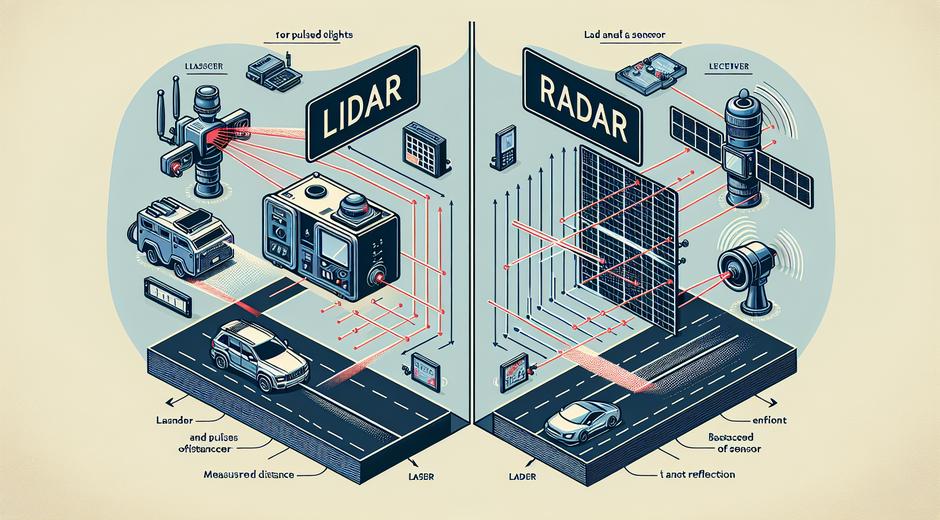


Lidar vs Radar: Which Sensor Is Best for Modern Cars
When automakers and tech developers talk about vehicle perception systems they often mention two core sensors Lidar vs Radar. Both sense the world around a car but they do so in very different ways. Understanding the differences helps car buyers vehicle designers and technology enthusiasts evaluate safety performance and cost. This article explains how each technology works compares their strengths and weaknesses and explores how they work together in real world systems.
How Lidar Works
Lidar stands for light detection and ranging. A Lidar unit emits pulses of infrared light and measures the time it takes for each pulse to return after hitting an object. By repeating this process thousands to millions of times per second the system builds a three dimensional map of the environment. This high level of detail makes Lidar ideal for precise object detection and classification.
In automotive use Lidar provides high resolution point clouds that reveal the shape size and position of pedestrians vehicles curbs and road signs. That level of spatial accuracy supports advanced tasks such as lane keeping complex parking maneuvers and detailed scene reconstruction. Because Lidar uses light it can resolve small features at medium range making it a strong choice when fine spatial detail is essential.
How Radar Works
Radar stands for radio detection and ranging. It emits radio waves and measures how waves reflect off objects. Radar relies on longer wavelength signals compared to Lidar which allows radio waves to travel through common obstructions such as rain fog and dust. Automotive radar systems operate at microwave frequencies and provide reliable range and velocity data even in poor weather conditions.
Radar excels at detecting objects at long range and measuring their relative speed with high accuracy. That strength makes radar useful for adaptive cruise control blind spot detection and collision avoidance. Radar returns contain less spatial detail than Lidar but they provide excellent motion information and robust performance in rain snow and light fog.
Key Differences in Performance
Comparing Lidar vs Radar requires looking at several performance dimensions. Lidar delivers higher spatial resolution. It can capture detailed three dimensional shapes and separate closely spaced objects at medium ranges. Radar provides better range sensitivity and motion detection with strong performance in adverse weather. In short Lidar gives clarity Radar gives resilience.
Another difference is the field of view. Lidar systems can either rotate to capture a surrounding view or use solid state arrays to achieve wide coverage. Radar units often have fixed coverage sectors and multiple modules are used to cover front rear and side zones. Lidar point clouds are dense while radar returns are sparse and often require algorithmic processing to interpret object size and shape.
Cost and Practical Considerations
Cost remains a major factor in the Lidar vs Radar debate. Historically Lidar units were expensive which limited adoption to high end prototypes and research vehicles. Recent advancements in manufacturing and solid state designs have driven Lidar prices down but the cost per unit still tends to be higher than comparable radar sensors. Radar enjoys decades of automotive scale production which keeps unit costs relatively low.
In addition to sensor cost integration complexity matters. Lidar systems may need cooling or careful mounting to maintain calibration. Radar modules are compact robust and easier to integrate into bumpers and grills. From a maintenance perspective radar units often require less cleaning while Lidar performance can degrade if the optical window is obscured by dirt or ice.
Weather and Environmental Sensitivity
One of the most important practical distinctions is how each technology performs in less than ideal weather. Because Lidar uses light it can be affected by heavy rain dense fog and snow which scatter infrared pulses and reduce effective range. Some Lidar models mitigate this by using multiple wavelengths or advanced filtering but the physics still creates limits in severe conditions.
Radar uses radio frequency energy that penetrates many types of atmospheric interference. That means Radar continues to detect vehicles and large obstacles reliably even when visibility is poor. For highway speed safety systems that rely on detecting moving objects radar resilience is a major advantage.
Resolution and Classification
Lidar provides detailed three dimensional data which enables better shape based classification. A Lidar point cloud can help algorithms determine whether an object is a bicycle a pedestrian or a motorcycle. This detailed classification capability supports nuanced decision making in complex urban driving scenarios.
Radar offers limited spatial resolution but provides direct measurement of object velocity. That velocity measurement simplifies tracking of moving objects and predicting trajectories. For many safety systems combining range and velocity from radar with shape and position from Lidar yields a complete picture that neither sensor can provide alone.
Safety and Redundancy
Lidar vs Radar is not always a choice of one or the other. Leading vehicle architectures adopt sensor fusion strategies that combine cameras Lidar and Radar to build robust perception stacks. Fusion provides redundancy which enhances safety. If Lidar performance degrades in heavy rain radar still detects major obstacles. If radar returns are confusing in a cluttered environment Lidar supplies the spatial clarity needed for accurate classification.
Regulators and safety engineers often prefer redundant sensing because it reduces single point failures. In many autonomous prototypes companies add both sensors along with multiple cameras to meet high safety targets and to create graceful failure modes.
Use Cases by Vehicle Type
Different vehicles favor different sensor mixes. High end autonomous taxis and research vehicles commonly include both Lidar and Radar to maximize perception performance in all scenarios. Consumer vehicles often prioritize cost and therefore rely heavily on radar and camera systems for driver assistance features. As Lidar prices fall more mainstream models may include basic Lidar units for parking and low speed maneuvers while keeping radar for highway safety functions.
Commercial fleets focused on long haul trucking may emphasize radar for robust long range detection and collision avoidance. Urban delivery robots might favor Lidar for precise obstacle avoidance in dense pedestrian environments. Matching sensor choice to mission profile is critical when weighing Lidar vs Radar options.
Future Trends
Advances in solid state Lidar design and chip scale radar integration promise continued evolution of both technologies. Machine learning and improved sensor fusion algorithms are closing the gap between sensor limitations and real world performance. Expect to see more affordable Lidar units combined with smarter radar processing enabling safer and more capable driver assistance systems.
Policy and regulation will also shape adoption. As safety standards mature and more real world data emerges regulators may specify minimum sensing requirements for certain automation levels. That will drive OEMs and suppliers to select sensor mixes that balance cost performance and reliability.
Practical Advice for Car Buyers
If you are evaluating vehicles consider the types of driving you do most often. For frequent highway travel and long trips radar centric systems deliver strong safety benefits in varied weather. For urban driving with complex scenes and close obstacles Lidar enhanced systems provide better spatial awareness. Many modern vehicles blend sensors so look for systems that emphasize redundancy sensor fusion and clear information about how the sensors perform in rain fog and snow.
For more insights on car technology and detailed reviews visit autoshiftwise.com where we cover sensor trends vehicle features and real world performance tests.
Learning More
If you want to dive deeper into the physics and signal processing behind these sensors there are excellent educational resources that explain Lidar design radar wave propagation and algorithmic fusion techniques in depth. A helpful learning portal with practical courses and clear guides is available at StudySkillUP.com which can accelerate your understanding of these core technologies.
Conclusion
The Lidar vs Radar question does not have a one size fits all answer. Lidar offers unmatched spatial detail while Radar excels at long range motion detection and all weather operation. The best automotive systems combine strengths of both sensors with cameras and sophisticated software to create reliable perception stacks. For consumers the optimal choice depends on driving needs budget and safety priorities. As technology progresses expect wider adoption of combined sensor systems that bring higher levels of safety and autonomy to everyday vehicles.